



ERRβ
ERRβ (ESRRB/NR3B2) is an orphan nuclear receptor transcription factor that shows constitutive transcriptional activity and binds estrogen-related response elements, while no cognate physiological ligand has been identified for ERR family members[1][2]. Mechanistically, ERRβ supports stem-cell programs: in mouse embryonic stem cells, ESRRB is a pivotal downstream target of the Gsk3/Tcf3 axis that regulates self-renewal[3]. ERRβ also interacts with Oct4 and positively regulates Nanog expression, linking this receptor to the core pluripotency network[4]. In trophoblast stem cells, Esrrb acts downstream of Fgf/Mek signaling and directly regulates trophoblast transcription factors, including Elf5 and Eomes, to sustain self-renewal[5]. In disease models, ERRβ suppresses in vitro and in vivo prostate cancer cell growth through p21^WAF1/CIP1 induction[6]. Compared with ERRα and ERRγ, which are strongly linked to cellular metabolism and oncogenesis, ERRβ remains distinguished by pluripotency, trophoblast biology, and alternative-splicing-dependent structure and function[1][2]. For experimental applications, DY131 and phenolic acyl hydrazones selectively activate ERRβ/ERRγ, whereas diethylstilbestrol regulates trophoblast stem-cell differentiation as an ERRβ ligand[7][8][9].
References:
- [1]. Divekar SD, et al. Estrogen-related receptor β (ERRβ) - renaissance receptor or receptor renaissance? Nucl Recept Signal. 2016 Jun 21;14:e002. [Content Brief]
- [2]. Huss JM, et al. Constitutive activities of estrogen-related receptors: Transcriptional regulation of metabolism by the ERR pathways in health and disease. Biochim Biophys Acta. 2015 Sep;1852(9):1912-27. [Content Brief]
- [3]. Martello G, et al. Esrrb is a pivotal target of the Gsk3/Tcf3 axis regulating embryonic stem cell self-renewal. Cell Stem Cell. 2012 Oct 5;11(4):491-504. [Content Brief]
- [4]. van den Berg DL, et al. Estrogen-related receptor beta interacts with Oct4 to positively regulate Nanog gene expression. Mol Cell Biol. 2008 Oct;28(19):5986-95. [Content Brief]
- [5]. Latos PA, et al. Fgf and Esrrb integrate epigenetic and transcriptional networks that regulate self-renewal of trophoblast stem cells. Nat Commun. 2015 Jul 24;6:7776. [Content Brief]
- [6]. Yu S, et al. Orphan nuclear receptor estrogen-related receptor-beta suppresses in vitro and in vivo growth of prostate cancer cells via p21(WAF1/CIP1) induction and as a potential therapeutic target in prostate cancer. Oncogene. 2008 May 22;27(23):3313-28. [Content Brief]
- [7]. Yu DD, et al. Identification of an agonist ligand for estrogen-related receptors ERRbeta/gamma. Bioorg Med Chem Lett. 2005 Mar 1;15(5):1311-3. [Content Brief]
- [8]. Zuercher WJ, et al. Identification and structure-activity relationship of phenolic acyl hydrazones as selective agonists for the estrogen-related orphan nuclear receptors ERRbeta and ERRgamma. J Med Chem. 2005 May 5;48(9):3107-9. [Content Brief]
- [9]. Tremblay GB, et al. Diethylstilbestrol regulates trophoblast stem cell differentiation as a ligand of orphan nuclear receptor ERR beta. Genes Dev. 2001 Apr 1;15(7):833-8. [Content Brief]
-
ERRβ Related Products (5)
Related Products (5)

-
SLU-PP-332
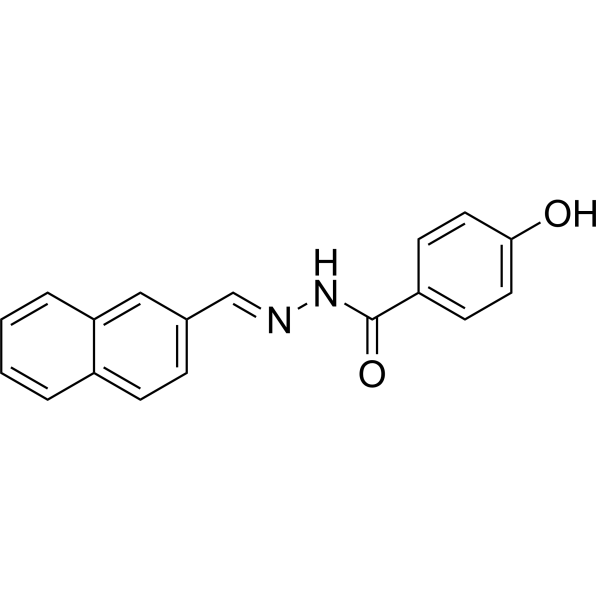 0 ImagesSLU-PP-332 is a pan-Estrogen Receptor/ERR agonist with EC50 values of 98, 230 and 430 nM for ERRα, ERRβ and ERRγ, respectively. SLUPP-332 enhances mitochondrial function and cellular respiration in skeletal muscle cell lines. SLU-PP-332 has the potential to study metabolic diseases as well as improve muscle function.
-
ERRγ-IN-1
 0 ImagesCat. No.: HY-177011CAS No.: 2170732-60-0ERRγ-IN-1 is a ERRγ inhibitor with an IC50 of 0.040 μM. ERRγ-IN-1 activates MAPK (p44/p42) and inhibits the activity of ERRγ. ERRγ-IN-1 significantly increases iodine uptake in anaplastic thyroid carcinoma xenografts and suppresses tumor growth in nude mice. ERRγ-IN-1 is applicable for the research of anaplastic thyroid carcinoma.
-
ERRγ inverse agonist 1
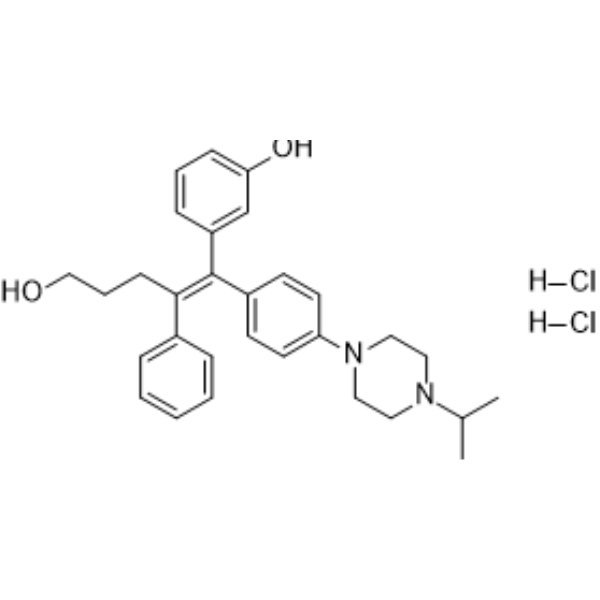 0 ImagesCat. No.: HY-114411CAS No.: 2316832-86-5



